
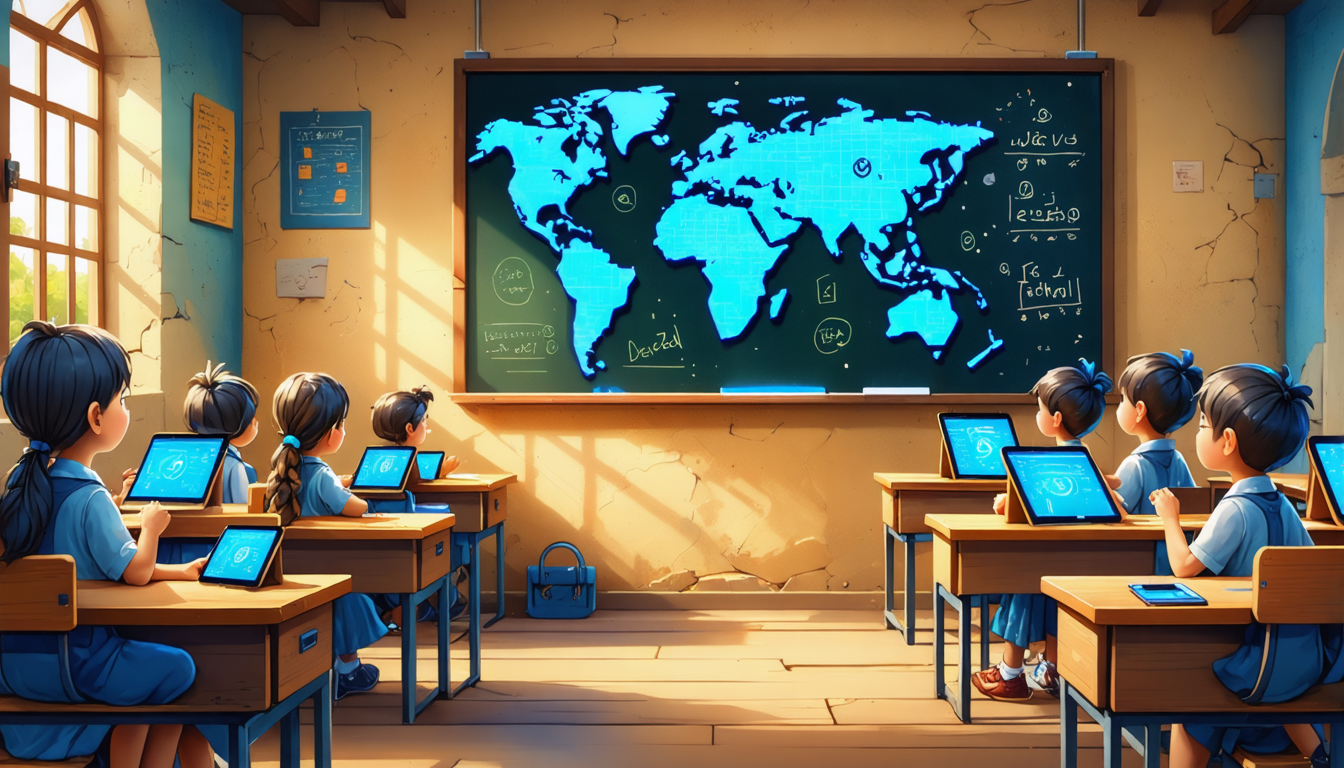
India has 1.4 million schools, 9.6 million teachers, and 264 million students enrolled in formal education. Yet the student-to-teacher ratio in many government schools exceeds 40:1, and in some states it’s even higher. Personalized education at that scale is impossible with human teachers alone.
That’s the challenge the Wadhwani AI for Education Hackathon took on. Running from March 5 to April 1, 2026, this offline hackathon asked participants to build AI-first prototypes for real-world education problems in India — solutions designed not just for impressive demos, but for actual impact, piloting, and scale in real classrooms.
The Challenge: AI That Actually Works in Indian Classrooms
Building AI for education isn’t just a technical problem — it’s a design problem rooted in understanding the constraints of Indian schools. Solutions need to work in classrooms where:
- Internet connectivity is unreliable or absent — many rural schools have no WiFi, and mobile data is expensive
- Students speak different languages — a student in Karnataka might think in Kannada but study textbooks in English
- Teachers have limited time for technology — they’re already stretched thin managing large classes
- Devices range widely — from shared tablets to basic smartphones to no devices at all
- Content must align with state curricula — India has different syllabi across states and boards (CBSE, ICSE, state boards)
- Cost must be minimal — government school budgets are extremely tight
The AI for Education Hackathon specifically asked for prototypes that could be piloted in real schools — not just impressive demos that fall apart outside a conference room or require infrastructure that doesn’t exist in most Indian schools.
Why Wadhwani AI?
Wadhwani AI is a nonprofit research institute that builds AI solutions for social good, with a specific focus on education and healthcare in developing countries. Their involvement meant the problem statements weren’t theoretical exercises — they came from real observations in Indian schools, informed by years of fieldwork.
This partnership between Wadhwani AI and Reskilll brought together Wadhwani’s deep domain expertise in education with Reskilll’s hackathon infrastructure, developer community, and event management capabilities.
What Teams Were Asked to Build
The AI for Education Hackathon focused on several key areas where AI can make the biggest difference in Indian education:
Personalized Learning at Scale
The central question: how do you give each student a personalized learning experience when one teacher handles 40+ students with varying abilities, backgrounds, and learning speeds?
Teams explored AI tutors that:
- Adapt to individual learning speeds through diagnostic assessments
- Identify specific knowledge gaps (not just “weak in math” but “struggles with fractions involving unlike denominators”)
- Provide targeted practice at the right difficulty level
- Work asynchronously so students can learn at their own pace
- Require minimal teacher intervention while keeping teachers informed of progress
Teacher Support and Augmentation Tools
Rather than replacing teachers — which is neither desirable nor practical — several problem statements focused on augmenting them. AI tools that help teachers:
- Identify struggling students early — before they fall too far behind, using patterns in classwork and attendance
- Generate lesson plans — aligned with the specific state curriculum and adapted to the class’s current level
- Create assessments — varied question papers that test understanding, not just memorization
- Track class-wide patterns — understanding which concepts the entire class struggles with, so teaching can be adjusted
- Reduce administrative burden — automating attendance, grading, and report generation
Multilingual Education Solutions
Language is one of the biggest barriers in Indian education. A student in rural Tamil Nadu might think in Tamil, speak a local dialect at home, and study textbooks written in English. Teams built AI solutions that bridge this gap:
- Translating educational content between languages while preserving pedagogical quality
- Providing explanations in the student’s native language when they’re stuck
- Helping with language learning itself — building English proficiency alongside subject knowledge
- Supporting code-switching — the natural way multilingual students actually think and learn
Assessment and Feedback Systems
Manual grading is one of the biggest time sinks for teachers. With 40+ students submitting work daily, meaningful feedback becomes impossible. Teams built AI systems that can:
- Evaluate student work — from multiple-choice tests to written answers to project submissions
- Provide detailed, constructive feedback that helps students improve (not just a score)
- Identify common misconceptions across the class
- Generate progress reports for parents in simple language
Why the Offline Format Was Chosen
Unlike many hackathons that run entirely online, the AI for Education Hackathon was deliberately designed as an offline event. Education technology needs to be tested with real users in real environments, and the offline format enabled:
- Direct collaboration — team members working side by side, iterating rapidly on ideas
- In-person mentorship — education experts and AI practitioners providing hands-on guidance
- Live testing and feedback — demonstrating prototypes and getting immediate reactions
- Cross-pollination — teams seeing each other’s approaches and building on shared insights
- Networking — participants connecting directly with the Wadhwani AI team and potential collaborators
From Hackathon to Real-World Pilot
What makes this AI for Education Hackathon fundamentally different from most hackathons is the explicit focus on what happens after the event ends. The problem statement emphasized solutions “designed for impact, piloting, and scale.” This means:
- Winning solutions have a path to real deployment — not just a trophy and a LinkedIn post
- Wadhwani AI’s network provides access to pilot schools — real classrooms with real students and real teachers
- The focus on practical constraints (connectivity, devices, languages, cost) means prototypes are closer to deployable products than typical hackathon demos
- Ongoing support — promising teams can continue developing their solutions with guidance from Wadhwani AI’s research team
This is the kind of hackathon that can genuinely change how education works in India — producing solutions that reach actual classrooms, not just impressive demos that get forgotten after the awards ceremony.
The Role of Reskilll’s Platform
Reskilll’s hackathon platform managed the end-to-end event logistics:
- Registration — participant signup with team formation and skill-based matching
- Problem statement distribution — clear challenge briefs for each track with supporting resources
- Submission management — collecting prototypes, documentation, demo videos, and technical write-ups
- Evaluation — structured judging with the Evaluator Platform providing AI-assisted scoring that analyzes code quality and project documentation
- Mentor coordination — connecting teams with relevant mentors through MentorVerse
Why Education Hackathons Matter for India
India’s education system serves more students than any other country except China. According to India’s Ministry of Education, the country is investing heavily in digital education infrastructure. Even small improvements in teaching effectiveness or learning outcomes, when scaled across 264 million students, have enormous national impact.
Hackathons like the AI for Education Challenge serve multiple critical purposes:
- Innovation pipeline — generating new ideas and approaches that traditional R&D processes might miss
- Talent discovery — identifying developers who are passionate about education technology and understand its unique constraints
- Community building — connecting AI developers with education domain experts, creating collaborations that persist beyond the event
- Rapid prototyping — testing ideas quickly and cheaply before committing to full development cycles
- Awareness — bringing attention to education challenges that the tech community might otherwise overlook
Get Involved in Education AI
If you’re a developer interested in building AI for education — or any social impact area — hackathons are the fastest way to get started. You don’t need to be an education expert. You need to be willing to listen to the people who are, understand their real challenges, and build solutions that work within their constraints.
Check Reskilll’s hackathon listings for upcoming education and social impact hackathons. The next one might be the event where your prototype becomes a product that reaches millions of students across India.
Comments are closed.