
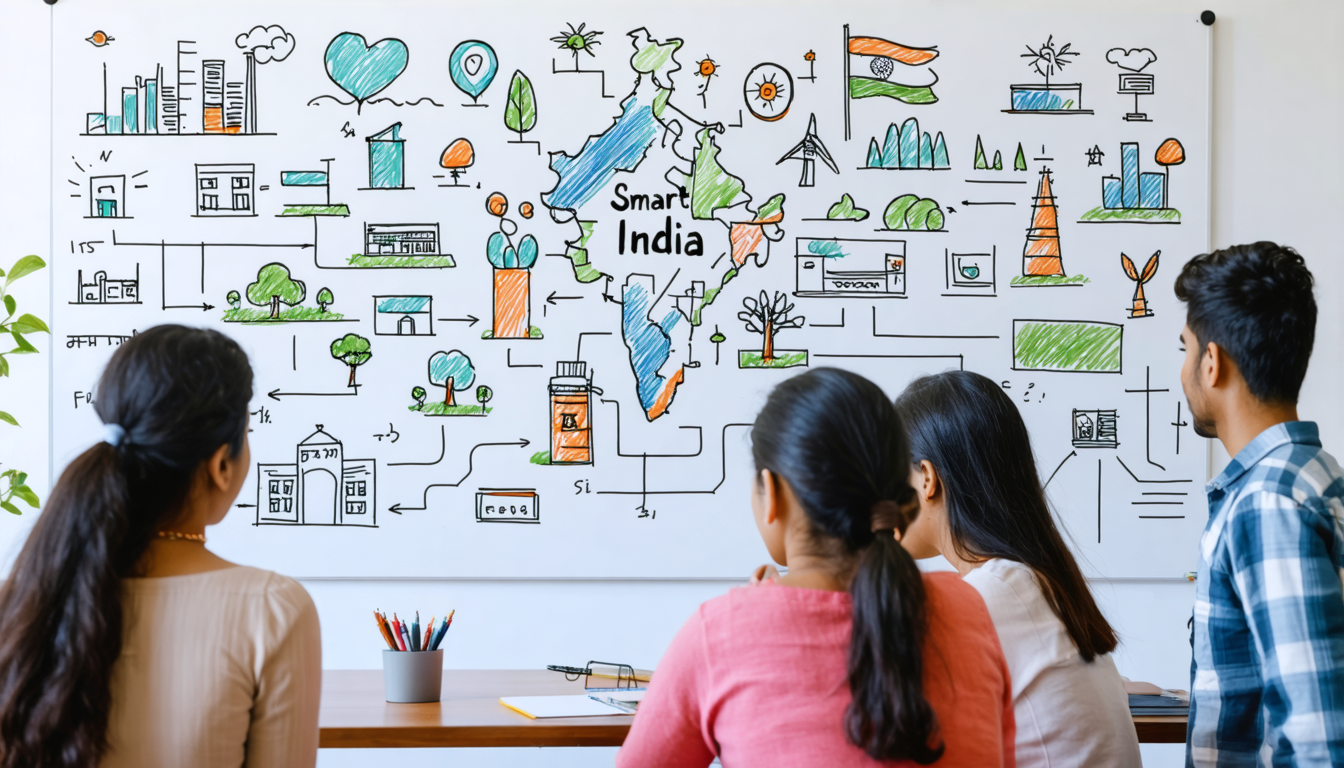
Smart India Hackathon (SIH) is back for 2026, and if you’re a college student in India, this is the one hackathon you cannot afford to miss. Organized by the Ministry of Education, SIH is the country’s largest government hackathon — with problem statements from real government ministries and organizations that need real solutions.
But here’s the challenge: with thousands of teams competing, your project idea needs to stand out. Here are proven Smart India Hackathon project ideas organized by theme, with practical tips on what judges actually look for.
How SIH Works
Smart India Hackathon runs in two phases:
- Internal Hackathon — your college runs an internal round. Top teams are selected to represent the college.
- Grand Finale — selected teams compete at nodal centers across India. 36 hours of non-stop building.
Problem statements come from government ministries (MeitY, Ministry of Health, Ministry of Agriculture, etc.) and organizations. Each problem statement has a specific department, a clear challenge, and expected outcomes.
SIH Project Ideas by Theme
Healthcare and Public Health
- AI-Powered Rural Health Screening — a mobile app that uses AI to screen for common diseases (diabetes, hypertension, eye conditions) using just a smartphone camera and basic inputs. Works offline for areas without connectivity.
- Medicine Authenticity Verifier — scan any medicine packaging and verify if it’s genuine using QR codes, batch numbers, and a government database. Tackles India’s counterfeit medicine problem.
- Mental Health Chatbot in Regional Languages — an AI chatbot that provides mental health support in Hindi, Tamil, Telugu, Bengali, and other languages. Culturally sensitive, available 24/7.
- Hospital Bed and Resource Tracker — real-time dashboard showing bed availability, oxygen supply, and ventilator status across hospitals in a district. Learned from COVID-19 challenges.
Agriculture and Rural Development
- Crop Price Prediction and Market Linkage — AI model that predicts crop prices using weather data, historical trends, and market demand. Helps farmers decide when and where to sell.
- Soil Health Card Digitizer — scan physical soil health cards, digitize the data, and provide AI-powered recommendations for fertilizer use and crop selection.
- Water Resource Management Dashboard — IoT sensors + AI to monitor groundwater levels, predict shortages, and optimize irrigation schedules for a village or district.
- Farmer Grievance Resolution Bot — AI agent that helps farmers navigate government schemes, file complaints, and track resolution status in their local language.
Education and Skill Development
- AI Tutor for Government School Students — personalized learning app aligned with state board curricula. Works on basic smartphones, supports regional languages. Similar to what teams built at the Wadhwani AI Education Hackathon.
- Skill Gap Analyzer — students input their current skills and target job role. AI identifies gaps and creates a personalized learning path with free resources.
- Exam Paper Generator with Bloom’s Taxonomy — AI tool for teachers that generates balanced question papers covering all cognitive levels, aligned with the syllabus.
Smart Cities and Urban Development
- Pothole Detection and Reporting — smartphone app that automatically detects potholes using accelerometer data while driving, maps them, and reports to the municipal corporation.
- Public Transport Optimization — AI that analyzes ridership data to suggest optimal bus routes, frequencies, and timings for a city’s public transport system.
- Waste Collection Route Optimizer — optimize garbage truck routes based on fill levels (IoT sensors on bins), traffic patterns, and collection schedules.
Governance and Citizen Services
- Government Scheme Eligibility Checker — answer simple questions and get matched with all government schemes you’re eligible for. Explains how to apply in plain language.
- RTI Request Assistant — AI that helps citizens draft Right to Information requests, suggests the correct department, and tracks response timelines.
- Land Record Digitization and Verification — OCR + AI to digitize handwritten land records, cross-reference with existing databases, and flag discrepancies.
Environment and Sustainability
- Air Quality Prediction and Alert System — predict AQI for the next 48 hours using weather data, traffic patterns, and industrial activity. Send alerts to vulnerable populations.
- Forest Fire Early Warning — satellite imagery + weather data + AI to predict forest fire risk and alert forest departments before fires start.
- Carbon Footprint Calculator for Indian Households — personalized carbon footprint tracking based on Indian lifestyle patterns (cooking fuel, transport, electricity usage).
What SIH Judges Actually Look For
Having seen thousands of hackathon submissions across 196 events on Reskilll, here’s what separates winners from the rest:
- Problem understanding (30%) — do you actually understand the problem? Have you talked to real users? Can you explain why existing solutions don’t work?
- Technical implementation (25%) — does it work? Is the code clean? Is the architecture sound?
- Innovation (20%) — what’s new about your approach? Why hasn’t this been done before?
- Feasibility and scalability (15%) — can this actually be deployed? What would it cost to scale?
- Presentation (10%) — can you explain it clearly in 5 minutes? Is the demo compelling?
How to Prepare for SIH 2026
- Practice at smaller hackathons first — join events on Reskilll to build your hackathon skills before SIH
- Learn AI tools — attend a Build With AI bootcamp to learn Gemini API and Google AI Studio
- Study past winners — look at what won in previous SIH editions and understand why
- Build your team — you need a mix of frontend, backend, AI/ML, and presentation skills
- Get a mentor — connect with experienced mentors on MentorVerse who have guided SIH teams before
Smart India Hackathon is your chance to build something that actually gets used by the government. Take it seriously, prepare well, and build something that matters.
These SIH project ideas are way more practical than what I found elsewhere. The Government Scheme Eligibility Checker is brilliant — going to build this for our internal round.
The section on what judges actually look for is gold. Problem understanding at 30% makes sense — last year our team had great code but poor problem understanding and we did not make it past internals.